
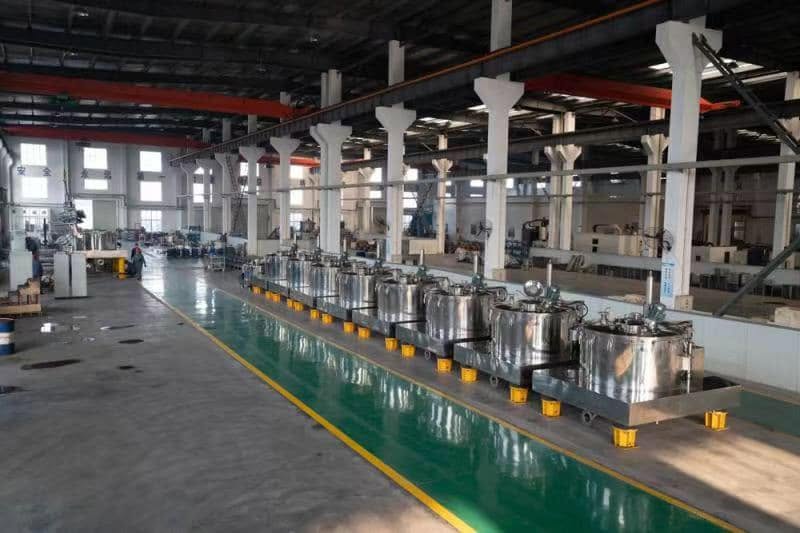
We manufacture 28 series and 100+ varieties of centrifuges — which means the harder question usually isn't "does Jowin make this," it's "which one." The right choice depends less on the industry you're in and more on how your process actually behaves: batch or continuous, how viscous or fine your material is, and whether you need pharma-grade cleanliness or just reliable throughput.
Here's the framework we walk customers through before recommending a model.
Start With These Questions
- Batch or continuous? Continuous operation suits steady, high-volume production; batch gives you more control over cake washing and cleaning between runs.
- What's your material's particle size and solids concentration? Fine crystals, coarse granules and fibrous slurries all separate differently.
- Do you need GMP or pharma-grade cleanliness? This narrows the field to models built for CIP washing and cGMP surface finishing.
- Are you handling flammable, explosive or hazardous materials? Nitrogen-protected and explosion-proof configurations exist for exactly this.
- What throughput do you need? Basket size and drive configuration scale very differently across our range.
Match Your Process to a Centrifuge Type
Continuous, High-Volume Liquid-Solid Separation → Decanter Centrifuge
If your process runs continuously and needs to handle large volumes of two- or three-phase slurry without stopping for discharge cycles, a decanter centrifuge is usually the answer.
- LW Horizontal Decanter Centrifuges — general-purpose continuous separation across chemicals, food and pharmaceutics.
- LW Drilling Mud Decanter Centrifuges — purpose-built for oilfield drilling waste.
- LWF Explosion-Proof Decanter Centrifuges — for flammable or explosive processing environments.
Batch Processing With High Automation → Vertical Scraper Bottom Discharge Centrifuge
When you need tight control over each batch — cake washing, discharge timing, cleaning — this category covers everything from GMP pharma production to viscous industrial slurries.
- LGZ/PGZ Automatic Bottom Discharge Scraper Centrifuges — fully automatic, PLC-controlled, GMP-grade surface finishing.
- PAUT/AUT Bottom Discharge Scraper Centrifuges — top-mounted motor, suited to viscous or hydrophilic slurries.
- PLD Pull Action Filter Centrifuge — our patented design for 99%+ cake removal.
- SGZ Three-Column Automatic Bottom Discharge Scraper Centrifuges — built for washing-heavy chemical and pharmaceutical processes.
Continuous or Fast-Switching Batch Operation → Horizontal Peeler Centrifuge
Peeler centrifuges give you fast cycle times and the flexibility to switch between continuous and batch operation on the same machine.
- GK Peeler Centrifuges — fast manual/automatic switching for flexible production.
- GKH Siphon Peeler Centrifuges — extra pushing force via siphon principle.
- GKF Pharma Peeler Centrifuges — fully sealed, cGMP-compliant for pharma and food-grade separation of toxic or flammable materials.
Fibrous or Granular Materials Needing Top Access → Manual Top Discharge Centrifuge
When your material is fibrous or granular and you need full physical access to the basket for cleaning or inspection, a top-opening design is usually more practical than a bottom-discharge one.
- PQSB Top Discharge Centrifuges — fully opening cover for complete cleaning access, CIP-ready.
- PSB Vertical Top Discharge Centrifuges — enclosed, time-verified design for general industrial use.
- PSD Top Discharge Centrifuges — simple filter-bag design, low-maintenance.
Continuous Crystalline or Granular Separation → Worm Screen Centrifuge
For continuous processing of crystalline salts and granular materials — think soda crystal, citric acid, potassium sulfate — a worm screen centrifuge's titanium-alloy basket and scroll handles the abrasive, repetitive-cycle work well.
- LLW Horizontal Worm Screen Centrifuge — continuous feeding, washing, dewatering and discharge in one cycle.
High-Volume Chemical, Fertilizer & Salt Processing → Pusher Centrifuge
When particle size is above 0.08mm and solids concentration runs 40% or higher, a pusher centrifuge's continuous feed-separate-wash-discharge cycle is built for exactly that scale.
- HR Pusher Centrifuge — proven for sodium chloride, potassium chloride, ammonium sulfate, urea and similar high-volume materials.
Not Sure Which Category Fits?
These categories can overlap — a viscous slurry might work in either a scraper bottom discharge or a peeler centrifuge depending on your washing and cleaning requirements. That's normal, and it's exactly what our team helps sort out on a call.
Tell Us About Your Process
Share your material, throughput and any GMP or safety requirements, and we'll recommend the right model and configuration.
Get a Recommendation